
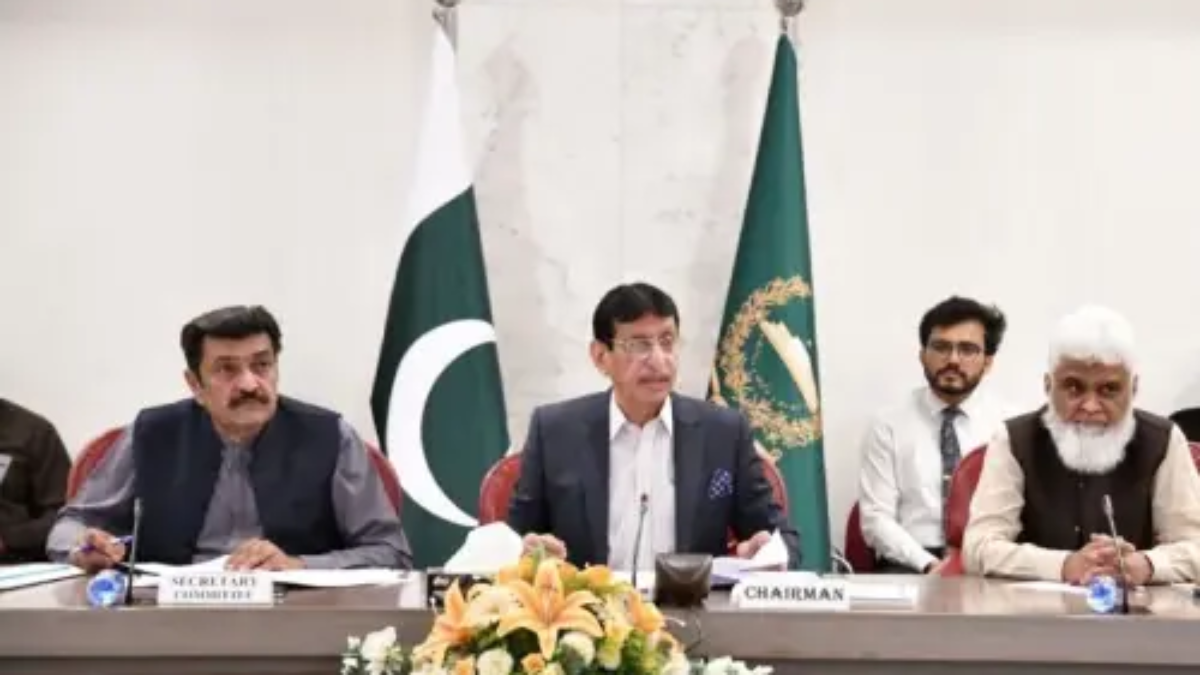
ISLAMABAD: On Tuesday, the National Assembly Standing Committee on Information Technology and Telecommunication voiced grave concerns about the nation’s inadequate internet services, pointing out that major cities like Karachi as well as remote areas were being negatively impacted by poor connectivity.
Syed Aminul Haque, the chairman of the committee, noted that despite numerous attempts, consumers frequently encountered sluggish internet connections and recurrent phone connection failures.
The committee was informed by PTA Chairman Hafeez ur Rehman that following the 5G specturm auction, the nation’s total accessible spectrum grew from 274MHz to 754MHz.
According to him, telecom companies have introduced 5G services in 22 cities. Nevertheless, he stated that 5G services had been enabled on current cell towers and network equipment and that no new infrastructure had been installed thus far.
He said that over the course of the following six to eight months, new 5G infrastrucure would be progressively installed in later stages, improving the speed and quality of internet services nationwide.
The committee noted that the lack of electricity for basic telecommunications infrastructure was one of the main issues influencing the quality of mobile and broadband services.
It was observed that extended power outages had a negative impact on mobile tower performance, leading to poor internet connectivity and consumer disruptions in mobile services.
Members reported that telecom services were severely impacted in some regions by loadshedding that lasted up to ten hours per day.
According to the PTA chairman, Nepra and the pertinent electricity distribution firms were consulted and brought on board to resolve the situation.
He stated that in order to offer the public with dependable telecommunication services, the prime minister had also established a high-level group to develop a permanent solution for guaranteeing the continuous power supply to telecom towers.
The committee noted that Pakistan had a sizable wind corridor with tremendous potential and suggested that alternative energy sources, especially wind energy, be used to power communications infrastructure.
Additionally, it suggested that the ministry order telecom companies to progressively construct renewable energy infrastructure at telecom locations, such as solar and wind power systems.
Tax on mobile phones
A briefing on the taxes levied on imported cell phones was also requested by the committee.
In response to a question, the PTA chairman told the committee that only 8% of smartphones mostly iPhones and Google Pixel devices – were imported, with the remaining 92% being made or assembled domestically.
He said that only imported mobile phones were subject to taxes, whereas the majority of other mobile phone brands were built in Pakistan and were therefore exempt from import charges.
The committee instructed the IT Ministry to promote the establishment of local production or assembly facilities in Pakistan by Apple and other top international smartphone manufacturers.
The PTA chairman explained that the PTA did not collect the taxes imposed on imported cell phones. He said that these taxes were instead deposited into the Federal Board of Revenue’s account.
He emphasized that the PTA simply registered and whitelisted the device through its Device Identification, Registration and Blocking System (DIRBS), allowing its legal usage in Pakistan, once the relevant taxes were paid.
Bill postponed
The Electronic Transactions (Amendment) Bill, 2026 was also presented to the committee for review.
Members of the Pakistan Peoples Party viced concerns throughout the discussion, claiming that the party’s Parliaentary Legislative Committee had not yet been consulted on the planned changes.
After members objected to suggested revisions that would transfer some powers from the federal government to the prime minister, the committee postponed approving the bill.
Aminul Haque, the chairman of the committee, questioned if the government had achieved political agreement on the proposed legislation.
Shaza Fatima Khawaja, the Minister of State for Information Technology, recongnized that there was no political agreement on the bill and reassured the committee that stakeholders would need to agree for it to be adopted.
The committee was informed by Ministry of Law officials that the proposed revisions only included two words: “prime minister” in place of “federal government”.
Sadiq Memon, a committee member, countered that the modifications would essentially give the prime minister more authority than the federal cabinet.
Before any changes were taken into consideration, PPP legislator Sharmila Faruqui proposed that the Minisrtry of Law give the committee a thorough briefing.
In response to the complaints, Khawaja stated that the proposed move was meant to expedite administrative decisions and that administrative decisions and that administrative matters frequently suffered delays since they had to go through the federal cabinet.
SOURCE: DAWN NEWS
Add a Comment